

Is a Grand Canyon Tour Worth It?
A visitor from Japan once told us she “just wanted to be in the Grand Canyon’s presence.” Anyone who has stood at the rim understands that. The first view is overwhelming — the colors, the scale, the silence. Many visitors simply gaze, and that is a perfectly valid way to spend time at the canyon.
But most people want more than presence. They want to understand.
You can absolutely visit on your own. The South Rim has well-marked viewpoints, paved paths, and interpretive signs at the major overlooks. The park entrance fee covers everything. You’ll see Mather Point, Yavapai Point, the Bright Angel trailhead. You’ll be genuinely impressed.
What the signs don’t easily convey is the story behind what you’re seeing. That’s where a guide makes the difference — and where Canyon Dave makes a bigger difference than most.
What a Guide Reveals
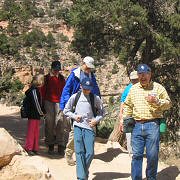
The dark rocks at the very bottom of the inner gorge are the Vishnu Schist — 1.8 billion years old, nearly half the age of Earth itself. The pale tan limestone at the very rim was the floor of a warm, shallow tropical sea 270 million years ago. You are standing on ancient seabed, looking down through almost two billion years of time.
Between those two layers is a gap of over a billion years with almost no rock record at all. Geologists call it the Great Unconformity — one of the most extraordinary geological features on the planet, visible to the naked eye from the rim. Most visitors walk past it without knowing it exists.
The canyon is geologically young, even though the rocks are ancient. The Colorado River only carved it about 5–6 million years ago — a short time geologically. The canyon’s entire history unfolds in four chapters, each readable in the rock layers if you know what you’re looking at. Canyon Dave has spent fifty years learning to read those chapters, and he has taught his guides to read them too.
At the Kaibab Formation near the rim, you can find the shells of sea creatures from the Kaibab Sea — brachiopods, crinoids, and corals that lived here 270 million years ago. Each guest gets a checklist and hunts for them personally. Canyon Dave calls it the Fossil Hunt at the Awesome Cracks. It sounds simple but the experience is unforgettable.
What Canyon Dave Adds That Other Tours Don’t
Secret shoppers from Trafalgar Tours wrote that the Canyon Dave Geology Presentation was the best talk they had ever heard on any tour.
Any decent tour gets you to the viewpoints. Canyon Dave Tours goes further:
- The Sit-at-the-Rim Geology Talk — Eight rock specimens pass around the group, one from each major layer. You hold a piece of 270-million-year-old limestone and a sliver of Vishnu Schist that formed when North America was still being built. No other tour does this.
- The Portable Museum — Canyon Dave has assembled a collection of canyon rocks, fossils, artifacts, and reference materials that travel with every tour. Guests examine real specimens, not photographs.
- Colorful take-home handouts — A visual record of everything you’ve learned, yours to keep. Most guests find they look at them again when they get home.
- The Fossil Hunt — Hands and knees at the Kaibab Formation, hunting real Permian shells with a picture checklist. Children and adults find this equally absorbing.
- Real conversation — Canyon Dave trains his guides to listen and respond rather than deliver a fixed script. Your questions shape the tour. Bring them.
A Self-Guided Visit vs. a Canyon Dave Tour
Here is an honest comparison:
On your own: You choose your own pace and viewpoints. The interpretive signs at Yavapai Point are genuinely good. The rim trail is beautiful. You’ll have an impressive experience — especially if you’ve done some reading in advance.
On a Canyon Dave tour: You cover more ground than most self-guided visitors manage, in a comfortable van with a window seat. You hear the geological story in the order it unfolded, from the oldest rocks upward. You handle specimens. You hunt fossils. You ask questions and get real answers from someone who has studied this canyon for decades. You leave knowing why the canyon looks the way it does — not just that it’s big.
Canyon Dave puts it this way: “Learning leads to love, and love to protection and care. You are doing something bigger than yourself.”
Ready to understand the Grand Canyon?
See Our Tours and BookAfter your tour, we’d love a review on TripAdvisor or Google.